Printing and dyeing sludge contains a large amount of organic pollutants, which will consume dissolved oxygen, destroy the ecological balance of water, and endanger the survival of fish and other aquatic organisms. Organic substances that sink under the water will generate harmful gases such as hydrogen sulfide due to anaerobic decomposition, which will deteriorate the environment. Therefore, the existence of printing and dyeing sludge poses a great safety hazard to human survival.
Printing and dyeing sludge drying machine Equipment overview:
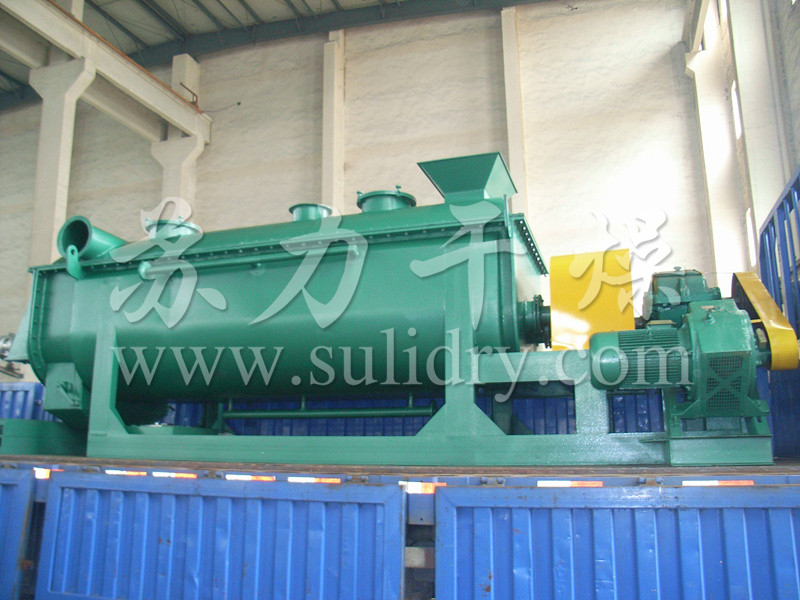
The paddle dryer is a horizontal agitating continuous drying device based on heat conduction. Because the agitating blade is shaped like a paddle, it is called a paddle dryer. It is also called a trough dryer or a stirring dryer in foreign countries.
Since the heat required for the drying of the device relies on heat conduction indirect heat exchange, the drying process does not require or require a small amount of gas to carry away the moisture. It greatly reduces the heat loss caused by the gas and improves the heat utilization rate. It is an energy-saving drying equipment.
Printing and dyeing sludge drying machine Principle:
The hollow blade dryer can indirectly heat or cool the paste, granular, powder, and slurry materials, and can perform unit operations such as drying, cooling, heating, sterilization, reaction, and low-temperature calcination. The special wedge-type agitating heat transfer paddle in the equipment has high heat transfer efficiency and self-cleaning function of the heat transfer surface.
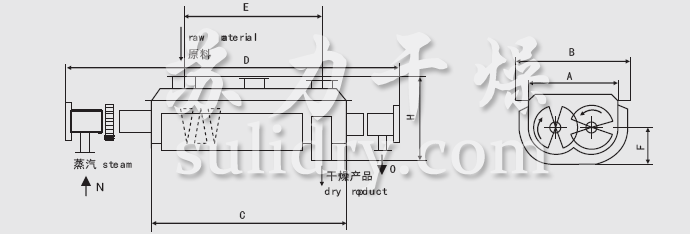
A wedge-shaped hollow blade is densely arranged on the hollow shaft, and the heat medium flows through the blade through the hollow shaft. The heat transfer area in the effective volume per unit is large, and the temperature of the heat medium is from -40 ° C to 320 ° C. It can be water vapor or liquid type: such as hot water and heat transfer oil. Indirect conduction heating, no air is carried away to remove heat, and heat is used to heat the material. The heat loss is only the heat dissipation to the environment through the insulation of the body. The wedge-shaped blade heat transfer surface has a self-cleaning function. The relative movement of the material particles and the wedge surface produces a scrubbing action, which can wash away the adhering material on the wedge surface, so that a clean heat transfer surface is maintained during operation. The housing of the paddle dryer is W-shaped, and two to four hollow agitator shafts are generally arranged in the housing. The housing has a sealed end cap and an upper cover to prevent material dust from leaking and collecting material solvent vapor. A baffle is arranged at the discharge port to ensure the height of the material level, so that the heat transfer surface is covered by the material and fully functions. The heat medium flows through the casing jacket and the hollow agitating shaft through the rotary joint, and the hollow agitating shaft has different internal structures according to the type of the heat medium to ensure a good heat transfer effect.
Printing and dyeing sludge drying machine Features:
1. The energy consumption of the blade dryer is low: due to indirect heating, there is not a large amount of air carrying heat, and the outer wall of the dryer is provided with an insulation layer, which is more energy-efficient than the usual convection drying.
2. The blade dryer system has a low cost: it has a huge heat transfer surface in the effective volume, which shortens the processing time and reduces the size of the device. It greatly reduces the building area and building space.
3. Wide range of processing materials: Different heat media can be used to process both heat sensitive materials and materials requiring high temperature treatment. Commonly used media are: water vapor, heat transfer oil, hot water, cooling water, etc. It can be operated continuously or intermittently and can be applied in many fields.
4. Small environmental pollution: no air is used, and dust materials are rarely entrained. The solvent evaporation of the material is small and easy to handle. Closed loops can be used for contaminated materials or for conditions requiring recovery of solvents.
5, low operating costs: the device is operating normally, only 1 hour / day · people. Low speed mixing and reasonable structure. The amount of wear is small and the maintenance cost is low.
6. Stable operation: Due to the special compression-expansion agitation of the wedge-shaped blade, the material particles are fully in contact with the heat transfer surface. In the axial interval, the temperature, humidity and mixing gradient of the material are small, thus ensuring Process stability.