

Nickel sulfate is an inorganic substance, easily soluble in water, slightly soluble in ethanol and methanol, and its aqueous solution is acidic, slightly soluble in acid and ammonia, and toxic. Mainly used in the electroplating industry, it is the main nickel salt for electroplating nickel and electroless nickel, and also a source of metal nickel ions, which can dissociate nickel ions and sulfate ions during electroplating.
Nickel sulphate dryer Working principle:
The wet material is continuously fed from the feeder to the first layer of the drying tray on the upper part of the dryer, and the raking arm with the raking leaves is rotated to make the raking arm make a rotary motion so that the rakes continuously pluck the material. The material flows along the exponential spiral through the surface of the drying tray, the material on the small drying tray is transferred to the outer edge, and falls to the outer edge of the large drying tray below the outer edge. On the large dry tray, the material moves inward and falls from the middle. The material is dropped into a small dry tray as follows. The size of the drying tray is alternately arranged up and down, and the material is continuously flowed through the entire dryer. A heating medium is introduced into the hollow drying tray. The heating medium is in the form of saturated steam, hot water and heat transfer oil. The heating medium enters from one end of the drying tray and is led out from the other end. The dried material falls from the bottom layer of the drying tray to the bottom layer of the casing, and is then transferred to the discharge port by the rakes. The moisture fraction escapes from the material and is discharged by the moisture discharge port provided on the top cover, and the moisture of the vacuum type tray dryer is discharged by the vacuum pump port provided on the top cover. The dry material discharged from the bottom layer can be directly packaged. By adding fin heater, solvent recovery condenser, bag filter, dry material back mixing mechanism, induced draft fan and other auxiliary machines, it can improve its drying production capacity, dry paste and heat sensitive materials, which can be easily recycled. Solvent and can perform pyrolysis and reaction operations.
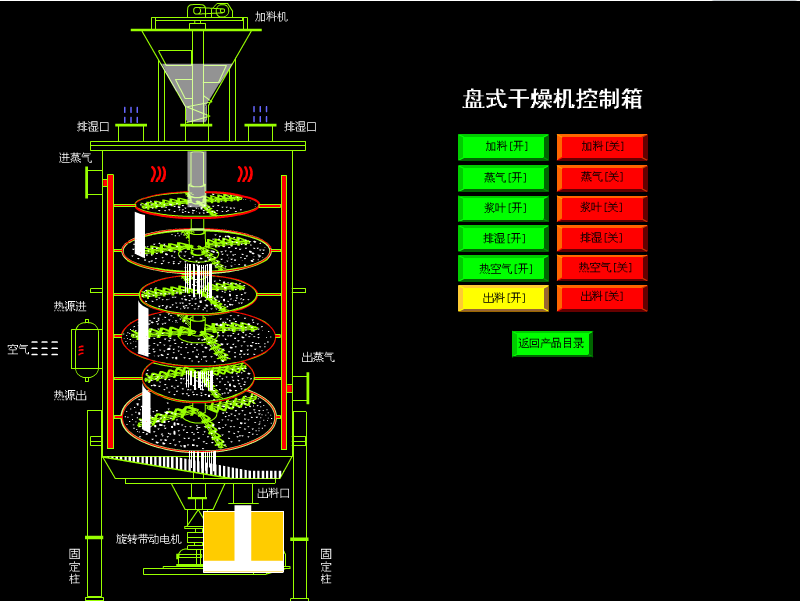
Nickel sulphate dryer Technical characteristics:
(1) Drying tray
◎ Design pressure: generally 0.4MPa, up to 1.6MPa.
◎High use pressure: generally ≤0.4MPa, ^ height up to 1.6MPa.
◎ Heating medium: steam, hot water, heat transfer oil, drying disc temperature 100 ° C using hot water heating, 100 ° C ~ 150 ° C with ≤ 0.4 MPa saturated steam or superheated steam, 150 ° C ~ 320 ° C with heat transfer oil Heating, >320 ° C can be heated by electricity, heat transfer oil, molten salt.
(2) Material conveying system
◎ Spindle speed: 1~10 rpm, electromagnetic or variable frequency stepless speed regulation.
◎ arm: There are 2 to 8 arms fixed on the main shaft on each drying tray.
◎ leaf: spliced on the arm, can keep in contact with the floating surface of the disk, there are many forms.
◎ Rolling: For materials that are easy to agglomerate and need to be pulverized, adding rolling at appropriate positions can enhance the heat transfer and drying process.
(3) The casing has three types: atmospheric pressure, airtightness and vacuum.
◎ Normal pressure type: cylindrical or octagonal prism type, with two structures, integral and split. The main pipe of the heating medium inlet and outlet may be inside or outside the casing.
◎ Closed type: cylindrical shell, can withstand 5Kpa internal pressure, the main pipe of heating medium inlet and outlet can be inside the shell or outside the shell.
◎ Vacuum type: cylindrical shell, design pressure is 0.1Mpa, the main pipe of heating medium inlet and outlet is inside the casing.
(four) air heater
It is generally used in the case of a large amount of evaporation to enhance drying efficiency.
Lubrication tips for disc continuous dryers:
The surface of the disc continuous dryer is designed to ensure that the entire assembly can be separated, and that the higher heat transfer rate in the rotor disk tends to cause the surface to come into contact with the medium, and at the same time, lubrication is required. Reduce wear and increase overall productivity.
PLG disc continuous dryer lubrication:
Lubrication is a general field, and lubricant technology often performs a variety of tasks from mechanical vision inspection, oil sample lubrication maintenance and application tasks, and a qualified lubricant technology can't just be an understanding of these tasks. In the process of using the dryer, we must do the maintenance work, so as to extend the service life of the dryer to a large extent, the maintenance method is to do the lubrication work.
If your dryer organization does not recognize a good lubrication job, it will be a very big problem because lubrication is the basis for the plant and its ability to sustain its mission. The role of maintenance is not that equipment repair has failed once, maintenance is to maintain plants and run the business, and the effective way to do so is to prevent failure, lubricant analysis is in the heart of maintenance because they deal with the root cause of elimination and monitoring failure, moisture and Ineffective separation of the contact surface.
Based on the basic configuration of the PLG disc continuous dryer, a mixer, a screw conveyor and a bucket elevator, an optional fin heater and an induced draft fan are provided to allow a small flow of hot air into the dryer. The escaping water of the dryer is taken away, which enhances the drying ability.

