

Tea polysaccharide is a kind of complex polysaccharide with certain physiological activity. The real name should be called tea active polysaccharide, which is different from the substantial polysaccharides such as fibrin, hemicellulose and starch in tea.
Tea polysaccharide is an acidic glycoprotein combined with a large amount of mineral elements called tea polysaccharide complex, referred to as tea polysaccharide or tea polysaccharide. The protein part is mainly composed of about 20 common amino acids. The sugar part is mainly composed of arabinose, xylose, fucose, glucose, galactose, etc. The mineral elements are mainly composed of calcium, magnesium, iron, manganese, etc. Elements such as rare earth elements.
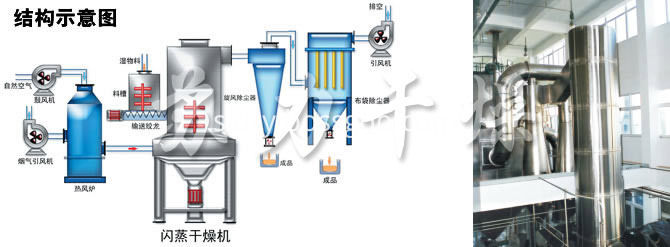
Tea polysaccharide drying machine works:
The hot air tangentially enters the bottom of the dryer and is driven by the agitator to form a powerful rotating wind field. The paste material enters the dryer by the screw feeder. Under the strong action of the high-speed rotating stirring paddle, the material is dispersed under the action of impact, friction and shearing force. The block material is rapidly pulverized, fully contacted with hot air and heated. ,dry. The dehydrated dry material rises with the hot gas flow, and the classification ring intercepts the large particles. The small particles are discharged from the center of the ring to the outside of the dryer, and are recovered by the cyclone separator and the dust collector. The dry material is not dried or the bulk material is subjected to centrifugal force. , fell to the bottom and was crushed and dried.
Tea polysaccharide special dryer performance characteristics:
◎ Organic combination of swirling, fluidizing, spraying and pulverizing and grading techniques.
◎Compact equipment, small size, high production efficiency, continuous production, realized
◎ "Small equipment, large production".
◎ Large drying strength, low energy consumption and high thermal efficiency.
◎The material has short residence time and good finished product quality, which can be used for drying heat sensitive materials.
◎ Negative pressure or micro-negative pressure operation, good airtightness, high efficiency and elimination of environmental pollution.
Tea polysaccharide special dryer adapts to materials:
Organic substances: Atrazine (pesticide insecticide), lauric acid barrier, benzoic acid, benzoic acid, bactericidal Dan, sodium oxalate, cellulose acetate, organic pigments, etc.
Dyes: antimony, black iron oxide, indigo pigment, butyric acid, titanium hydroxide, zinc sulfide, various azo dye intermediates.
Inorganic materials: borax, calcium carbonate, hydroxide, copper sulfate, iron oxide, barium carbonate, antimony trioxide, various metal hydroxides, various heavy metal salts, synthetic cryolite, and the like.
Food: soy protein, gelatinized starch, wine trough, wheat sugar, wheat starch, etc.
Rotary flash dryer basic structure:
The main structure of the rotary flash dryer includes a feeder, a classifier, a drying tower body, a discharge (gas) port, a stirrer, an air inlet, and the like. The bottom of the dryer is designed as a unique inverted cone-shaped drying cone, which together with the inner cylinder forms a dense phase fluidization zone with a small cross-sectional area. There is a narrow annular air inlet-annular gap between the lower edge of the cone and the hot air chamber, and the air inlet chamber is designed in the shape of a volute. These designs ensure that the hot air rotates at high speed into the drying zone. The material enters the drying tower through the feeder 1. During the falling process, it is continuously pulverized into fine particles due to the impact of the rising hot air flow and the agitator. First, heat and mass transfer is carried out in the fluidized area and the hot air, and the fine particles will follow the air flow. Ascending and continuing to dry, the material with acceptable particle size and moisture is discharged through the classifier 2 and the discharge port 4, and the remaining materials are returned to the drying zone by the classifier. In the fluidized area, the lower cross-sectional area is small and the wind speed is high, which is conducive to the return of the bulk material back to the fluidized zone, avoiding the subsidence to the bottom and blocking the annular inlet zone.
