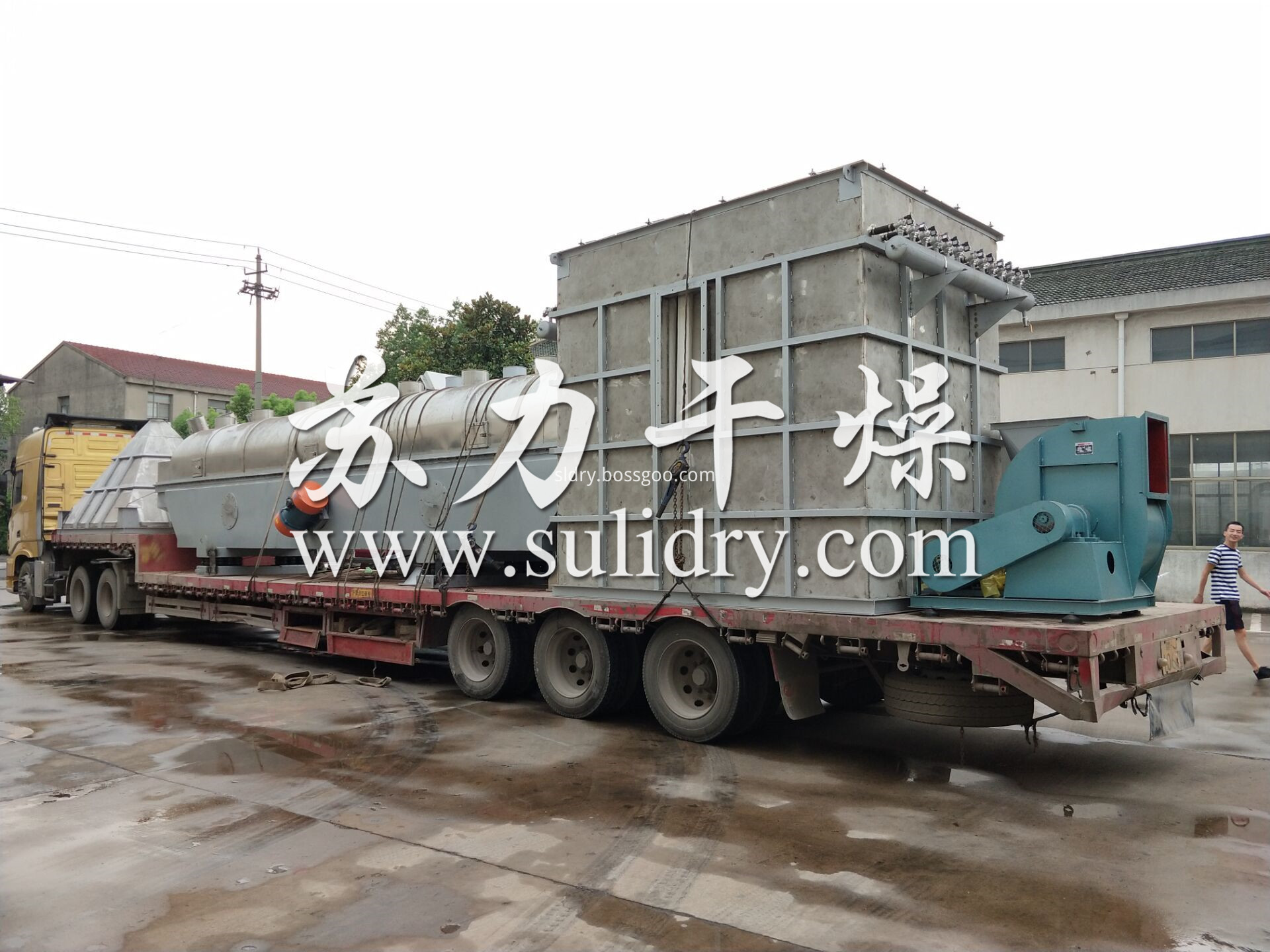
Iminodiacetonitrile is a pale yellow to brown powder. Soluble in water (solubility 6 ~ 7 grams, 25 ° C), soluble in organic solvents such as acetone. This product is mainly used for the synthesis of herbicide glyphosate. In addition, as an important fine chemical intermediate, it has a wide range of applications in dyeing, electroplating, water treatment, synthetic resin and other fields.
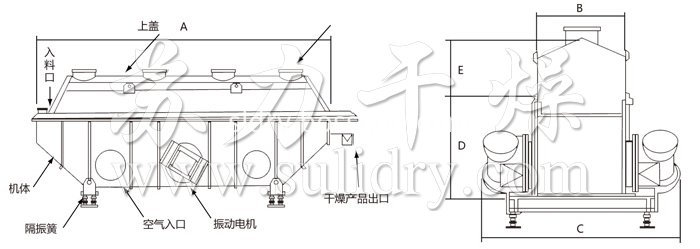
The working principle of iminodiacetonitrile dryer:
The material enters the machine from the inlet of the feed. Under the action of the vibration force, the material is thrown along the fluidized bed of the horizontal plane, and moves forward continuously. The hot air passes through the fluidized bed and exchanges heat with the wet material, and the humid air is removed by the cyclone. Exhausted by exhaust 1:3. The dry material is discharged from the discharge inlet.
Vibrating fluidized beds offer significant advantages over traditional drying techniques:
1. High interest rates for heat transfer and mass transfer ensure faster and more uniform drying, faster than other methods such as ovens and vacuum drying.
2. Drying time is from a few seconds to a few minutes. Completely dry is usually at 15 minutes, the specific time for a given sample, the setting is very repetitive airflow speed and temperature. Uniform, reproducible, moisture content can also be achieved with appropriate settings.
3. The moisture content of the material can be dried from a few percent to more than 80 percent. At room temperature 200, the inlet air temperature range covers most of the solvent removed by drying. Due to good mixing, the sample temperature is uniform and the drying process is tightly controlled, which proves to be advantageous for drying heat sensitive materials or coated particles.
4, it can process a wide range of materials, mainly pharmaceutical, chemical, mineral, food, coal, wood chips, plastics, resins and so on.
The high performance of the vibrating fluidized bed allows it to be used in addition to drying, as well as many other applications such as:
1. Rapid determination of moisture content (eg coal, tobacco, food), relevant treatment no more than 5 minutes, while using the specified drying conditions.
2, solid mixing, granulation and agglomeration, coarse classification of particle size.
Fluidized bed dryer Conditions of use:
1. There is a certain limit on the particle size of the dried material, generally more than 30um and less than 6mm. The particle size is too small to be entrained by the gas stream, and the particle size is too large to be vulcanized.
2. If several materials are mixed together for fluidized bed drying, the relative densities of several materials are required to be close. Otherwise, particles of relatively low density are more likely to be entrained by the gas stream than particles of relatively high density, and also affect their dryness.
3. Materials with high water content and easy to bond into a group are generally not applicable.
4, easy to wall and agglomerated materials, in the vulcanization and drying is easy to produce equipment wall and plugging.
5. The material in the bed of the fluidized bed drying equipment is longitudinally mixed back. Continuous drying on a single pole, because the material stays in the equipment in an uneven time, will make the product dry and uneven and will be discharged.
6. Materials that require a beautiful appearance on the product should not be used. For valuable and toxic materials, careful consideration should be given to a complete recycling unit.
Iminodiacetonitrile dryer Advantages:
1. In the fluidized bed drying equipment, the fluid is fully mixed with the solid particles, and the surface renewal opportunities are many, which greatly enhances the heat transfer and mass transfer between the two phases, so the temperature inside the bed is relatively uniform. At the same time, it has a very high heat capacity coefficient (or volumetric heat transfer coefficient), which can generally reach 8000-25000KJ/(m?·h·°C). The production capacity is large, and the maximum drying capacity is several hundred tons per hour.
2. Compared with the old box drying equipment or the rotary drum drying equipment, the fluidized bed drying equipment has the advantages of short material residence time and large drying rate; it is also suitable for drying certain heat sensitive materials.
3, the equipment is simple, easy to manufacture, easy to maintain, and easy to enlarge the equipment.
4. The residence time of the materials in the fluidized bed drying equipment can be adjusted according to the production requirements of the process. Appropriate adjustment can be made when the product moisture content changes or the moisture content of the raw material fluctuates.
5. In the same equipment, continuous operation can be generated, and intermittent operation can be performed.