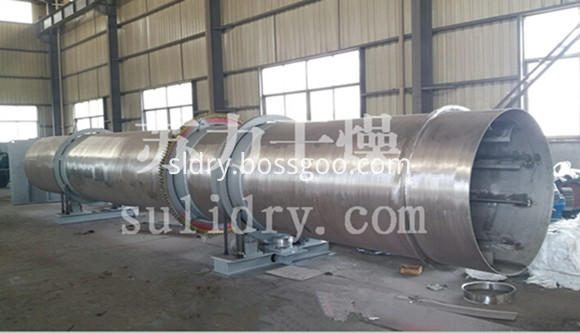
Zinc oxide is an oxide of zinc. Hard to dissolve in water, soluble in acid and alkali. Zinc oxide is a commonly used chemical additive widely used in the production of plastics, silicate products, synthetic rubber, lubricating oils, paints, ointments, adhesives, foods, batteries, flame retardants and other products. Zinc oxide has large band gap and exciton binding energy, high transparency, and excellent room temperature luminescence performance. It is used in liquid crystal displays, thin film transistors, light-emitting diodes and other products in the semiconductor field. In addition, microparticulate zinc oxide has also begun to play a role in related fields as a nanomaterial.
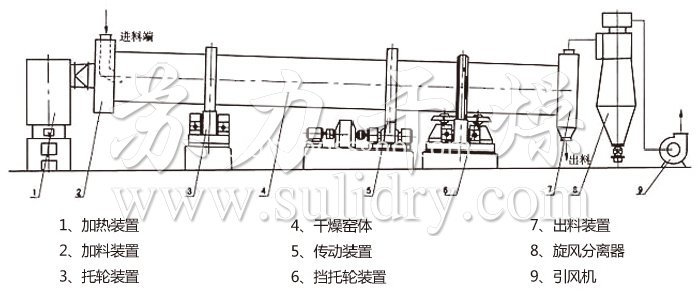
Zinc oxide dryer Working principle:
After the wet material is put into one end of the dryer, the material is evenly distributed and dispersed in the dryer under the flipping of the inner tube, and the material is fully contacted with the cocurrent (countercurrent) hot air to accelerate the drying heat transfer. Passed to the driving force. In the drying process, under the action of the inclined plate and the hot air flow, the material can be adjusted to the other side of the dryer to discharge the finished product.
Zinc Oxide Dryer Adapted to materials:
◎ Large particles in the chemical, mining, metallurgical and other industries, such as: mine, blast furnace slag, coal, metal powder, phosphate fertilizer, ammonium sulfate.
◎ Drying of powder and granular materials with special requirements, such as: HP foaming agent, distiller's residue, light calcium carbonate, activated clay, magnetic powder, graphite, dregs.
◎Requires low temperature drying and requires large quantities of continuous drying materials.
Zinc Oxide Dryer Features:
◎The drum dryer has a high degree of mechanization and a large production capacity.
◎The fluid passes through the cylinder with low resistance and low functional consumption.
◎ The adaptability to material properties is relatively strong.
◎ stable operation, low operating cost, and good uniformity of product drying.